FAQ
T_LOGIN Log in

Don't have an account on our website?

T_REGISTER Register
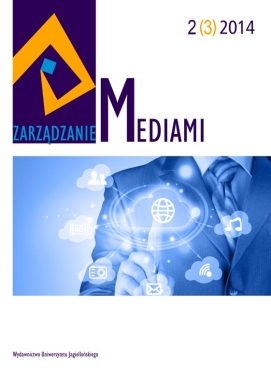
frontcover of Zarzadzanie-Mediami Latest Issue Next
Editor-in-Chief:
Prof. dr hab. Bogusław Nierenberg
Deputy Editor-in-Chief:
Dr Anna Modzelewska

Affiliation: Jagiellonian University in Kraków

Periodicity: Quarterly

Year of foundation: 2013

Go to journal page Next

Article languages: english, polish

Status: active

Licence: CC BY, open access

Demand fees: No

Scientific domain: Communication and media studies, Social sciences

Journal type: Scientific

eISSN: 2354-0214

UIC ID: 488195

DOI: 10.4467/23540214ZM

MNiSW points: 40

Journal description

The journal "Media Management" is the first Polish-reviewed scientific journal concerning media management issues. The journal is issued in the form of web quarterly, addressed to the researchers of the media and management, as well as all persons interested in the subject. The aim of the journal is to study and describe the theoretical and practical issues related to the media management, information, advertising and media institutions.

Issue presentation

see all issues Next

Volume 13, Issue 4

Publication date: 21.01.2026

Editor-in-Chief: Bogusław Nierenberg

Deputy Editor-in-Chief: Anna Modzelewska

Issue's Editor: Bogusław Nierenberg

The publication of this volume was financed by the Jagiellonian University in Kraków – Faculty of Management and Social Communication & Institute of Culture

Cover design: Agnieszka Mitoraj

Bogusław Nierenberg

Media Management, Volume 13, Issue 4, 2025, pp. XI-XV

https://doi.org/10.4467/23540214ZM.25.022.22918
Read more Next

Stanisław Jędrzejewski

Media Management, Volume 13, Issue 4, 2025, pp. 259-275

https://doi.org/10.4467/23540214ZM.25.023.22919
The article aims to outline the role that Telewizja Polska (Polish Television) and Polskie Radio (Polish Radio) played in the realisation of the state’s modernisation ambitions and shaping the post-war intellectual climate. In particular, the analysis concerns educational and scientific programs as instruments of social policy and as carriers of the ideology of progress and rationalism. By outlining the programming structure of Polish Radio and Polish Television at the time, this article focuses on the importance of the then state-owned public media in the pursuit of building a modern society in Poland, as well as the relevance of research on this phenomenon in the context of contemporary debates on the role of public media in the processes of education and modernisation.
Read more Next

Juliusz Braun

Media Management, Volume 13, Issue 4, 2025, pp. 277-284

https://doi.org/10.4467/23540214ZM.25.024.22920
Security, in the broadest sense of the word, requires enormous financial expenditure. Equally important, however, is the provision of social capital, garnered through the relationships and connections that bind individuals and social groups, facilitating completion of a multitude of tasks, and measured primarily by the level of mutual trust. A group with a high degree of mutual trust is capable of achieving more than one which lacks it. Proper functioning of the media expedites the growth of social capital. Public local media have both specific responsibilities and greater opportunities for action in this regard. Rooted in the ‘small homelands’ and drawing on shared experiences, cultural traditions, and even customs, on the matters near to their recipients’ hearts, they occupy an advantageous position when it comes to fostering a sense of community and faith in its worth. These media, operating close to their audiences, are familiar with the needs and interests of these groups and are capable of quickly acquiring and disseminating reliable information concerning local communities. They can also respond quickly to fake news emerging within local information spaces.
Read more Next

Bogusław Nierenberg, Zbigniew Bujak

Media Management, Volume 13, Issue 4, 2025, pp. 297-309

https://doi.org/10.4467/23540214ZM.25.026.22922

Historia magistra vitae est – this maxim of Cicero (De oratore 2.36) reminds us that we should draw conclusions from what happened in the past in order to avoid mistakes in the future. For several decades we have been struggling with the question of how to repair the media, especially public media. The authors of this article look for inspiration for their reflections in the early 1980s – the time that initiated the Solidarność (Solidarity) revolution in our country. We assumed that subsequent events in our history confirm the truth of a statement made half a millennium ago by Niccolo Machiavelli (1984, p. 111): “Wise men say, and not without reason, that those who wish to foresee the future must consult the past, for human events always resemble those of earlier times. This arises from the fact that they are produced by men who have been, and ever will be, animated by the same passions; and thus they must necessarily have the same results”.
In 1980, a movement was born in Poland that resonated loudly throughout the world. It took the organizational form of a trade union independent of the communist authorities and the symbolic name “Solidarity”. It was a multidimensional movement, touching upon many aspects, including the media. We analyze how, over the more than 40 years that have passed, the role, significance, and also the independence of the Polish media have been perceived. It appears that the attitude of decision-makers toward the media has ranged between an Agora and a Colosseum: either they adopted a deliberative approach, whereby those in power, together with citizens, decide what content is published, or one based on the principle that whoever holds power – by the right of the stronger – should determine what reaches the audience.

Read more Next

Varia

Ada Adryańczyk, Anna Pol, Michał Otrocki

Media Management, Volume 13, Issue 4, 2025, pp. 317-329

https://doi.org/10.4467/23540214ZM.25.028.22924
The article examines government communication on the Instagram against the backdrop of the theory of technological determinism. In light of this theory, communication technologies determine communication (hard determinism) or create new communication opportunities that are not a necessity (soft determinism). The aim of the article is to explore government communication on the Instagram using German Ministry of Foreign Affairs (Auswärtiges Amt) as an example. Drawing on linguistics and media studies and using multimodal analysis, the authors check whether Instagram forms of expression, trends and viral formats have penetrated government communication about important national and international issues. Drawing on Magdalena Makowska’s multimodal analyses, the authors analyze the multimodality of government posts on Instagram. The conclusions from the qualitative analysis may become a contribution to further quantitative explanatory analyses and considerations on the role of platforms in contemporary society, not only at the local level but also at the national and international level.
Read more Next