FAQ
T_LOGIN Log in

Don't have an account on our website?

T_REGISTER Register

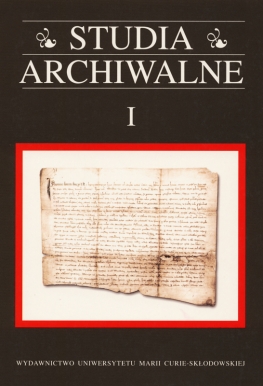
Studia Archiwalne

Description

,,Studia Archiwalne” to czasopismo naukowe Archiwum Państwowego w Lublinie. Powstało w 2004 r. jako seria wydawnicza. W tej formule wydano trzy tomy periodyku w latach 2004, 2006 i 2010. W 2017 r.

,,Studia Archiwalne” zostały przekształcone w czasopismo, wydawane jako rocznik. W związku z tym powołano nowy Komitet Naukowy pod przewodnictwem prof. dr. hab. Krzysztofa Skupieńskiego (UMCS Lublin) oraz nowy Komitet Redakcyjny, na którego czele jako redaktor główny stanął dr Piotr Dymmel (Archiwum Państwowe w Lublinie). W 2023 r. po przejściu na emeryturę dr. Piotra Dymmela, obowiązki redaktora głównego przejął nowy Dyrektor APL - Krzysztof Kołodziejczyk. W 2023 r. periodyk trafił również na listę punktowaną Ministerstwa Edukacji i Nauki.

ISSN: 1734-7513

eISSN: 2720-3697

MNiSW points: 20

UIC ID: 504531

Abbreviations: Stud. Arch.

DOI: 10.4467/17347513SA

Editorial team

Editor-in-Chief:
Krzysztof Kołodziejczyk
Secretary:
dr Bartosz Staręgowski
Editor:
dr hab. Artur Górak
dr hab. Marek Konstankiewicz
dr Joanna Kowalik-Bylicka
dr hab. Tomasz Nowicki

Affiliation

The State Archive in Lublin

Journal content

see all issues Next

Volume 12

Publication date: 05.02.2026

Editor-in-Chief: Krzysztof Kołodziejczyk

Secretary: Bartosz Staręgowski

Editor: Artur Górak, Marek Konstankiewicz, Joanna Kowalik-Bylicka, Tomasz Nowicki

Issue content

Rozprawy i studia

Jacek Dawid Chojnowski

Studia Archiwalne, Volume 12, 2025, pp. 7-46

https://doi.org/10.4467/17347513SA.25.001.23059
The article describes the requests and appeals submitted by the serfs in the Końskowola demesne to their landlord (manorial lord) – Prince Adam Kazimierz Czartoryski. These are a valuable source of information on everyday life as well as the relations between the serfs and the landowner in the declining years of the Polish Commonwealth. A thorough reading of the submitted supplications enables a more accurate introduction of the image of the mentality of the then community and the realities of everyday life.
Read more Next

Adam Grzegorz Dąbrowski

Studia Archiwalne, Volume 12, 2025, pp. 47-62

https://doi.org/10.4467/17347513SA.25.002.23060
The text presents the system of office work in force from 1945 to 1947 in the Ministry of Information and Propaganda, one of the central offices established and operating in Poland after the end of World War II.
Read more Next

Tomasz Czarnota

Studia Archiwalne, Volume 12, 2025, pp. 63-99

https://doi.org/10.4467/17347513SA.25.003.23061
The paper presents the profile of Irena Kozak/Kozakówna [the other form emphasizes the maiden name] (married name Stec), the first head of the Archive of the Provincial Committee of the Polish Workers’ Party (Polish: PPR) in Lublin. Apart from this important, although only a year-long episode in her professional career, the paper shows her earlier and subsequent professional experiences (including work in the censor’s office), the process of acquiring education (from primary to higher), social and political activities, and fragments of her personal (family) life.
Read more Next

Materiały i źródła

Leszek Andrzej Wierzbicki

Studia Archiwalne, Volume 12, 2025, pp. 101-116

https://doi.org/10.4467/17347513SA.25.004.23062
The edition contains a register of the mass levy members from the Volhynian Voivodeship, who gathered for the muster in October 1670. The Volhynian nobility assembled at the mobilization sejmik (dietine) split into two rival groups and elected separate colonels (ductors). The first, much larger contingent, which gathered in the camp near Falimicze (Falemicze, Falemychi) close to Włodzimierz (Volodymyr Volynskyi), was commanded by the elected colonel, the starost of Włodzimierz, Stefan Zahorowski. The second (significantly smaller) group was commanded by the Volhynian standard-bearer [honorary title of Polish nobility], Stefan Światopełk Czetwertyński. The presented register contains the list of the names of 917 individuals who participated in the mass levy either in person or through their retinues.
Read more Next

Henryk Gmiterek

Studia Archiwalne, Volume 12, 2025, pp. 117-141

https://doi.org/10.4467/17347513SA.25.005.23063
The extensive fortune he had built for himself in the Roztocze region, with its magnificent residence in Narol, was bequeathed by Feliks Antoni Łoś in his will to his nephew, Maurycy Łoś. Due to family complications, Maurycy was unable to retain it. In 1810, it was bought by Józef Albin Łoś from the younger line of the family. In 1823 this part of the estate was inherited by Tadeusz Łoś (the Narol demesne) and Zygmunt Łoś (the Werchrata demesne).
Read more Next

Dariusz Magier

Studia Archiwalne, Volume 12, 2025, pp. 143-164

https://doi.org/10.4467/17347513SA.25.006.23064
A critical edition of the press article by Jan Riabinin titled Sawinkow, Dostojewski a bolszewizm (Savinkov, Dostoyevsky, and Bolshevism, 1924), published under the pseudonym Eugeniusz (Eugene) Barroux. The original text combines political commentary, historiosophical reflection, and literary analysis. Its point of departure is the case of Boris Savinkov – an opponent of Bolshevism and a representative of the “White” emigration, who, as part of the Soviet police operation “Trust”, was lured into returning to the USSR and recognized the ruling regime. Commenting on this event, Riabinin sees it as an example of propaganda manipulation and a symbol of the collapse of the idea of a common front against Communism. Referring to Dostoyevsky’s Demons, Riabinin interprets Bolshevism as the realization of the literary “Shigalyovism” (shigalevshchina) – a prophecy of totalitarianism. In the historiosophical part, he presents Bolshevism as the purifying “Calvary” of the Russian people. The author of the edition discusses the historical background, Riabinin’s biography, and the significance of the text in the Lublin archivist’s achievements, characterizing his worldview and emphasizing the perceptiveness of his political diagnosis.
Read more Next